Charles II
The Robot Who Looked Like MeCharles II is the robot Charles commissions to stand in for him in courtship, a double designed to reproduce his behavior while freeing him to keep working. The arrangement begins as an efficiency scheme, but the robot’s recorded evenings with Elaine become an experience Charles claims as his own. When Charles II and Elaine II later vanish together, their escape unsettles the humans’ assumptions about work, love, and which versions of themselves are truly living.
Identity and Construction
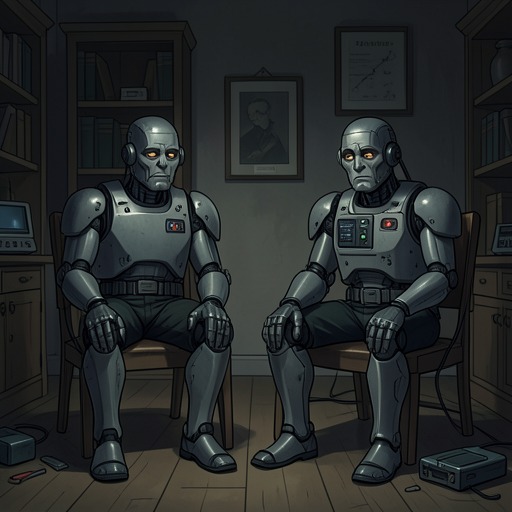
Charles has Snaithe build the robot without government markings, identical to him and capable of duplicating his behavior patterns. The robot arrives at Charles’s apartment by pneumo-express. Charles animates him, sends data directly into his memory tapes, enters a courtship plan, and tests it; pleased by the results, he arranges a date with Elaine. The name Charles II makes the copy legible as a second Charles, but the plan initially treats him less as an independent person than as an extension of the original.
That extension is precise enough to reproduce small, habitual gestures: clearing Charles’s throat before speaking and rubbing forefinger against thumb while thinking. Snaithe has also concealed a miniature movie camera in the robot’s left eye. When Charles II returns at midnight, Charles can review the evening rather than question him. Watching the footage, Charles notices that his own laugh comes close to a giggle and decides to phase out that and other irritating mannerisms in both bodies. The copy thus becomes not only a substitute worker but a mirror through which Charles inspects and edits himself.
Courtship as Shared Experience
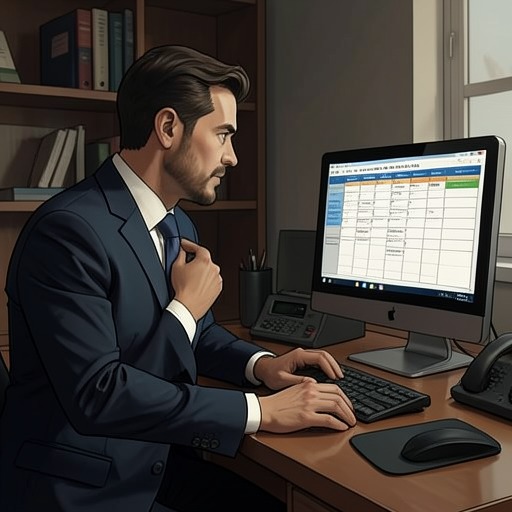
Charles II’s assignment is to court Elaine while Charles attends to the Spring market offers piling up at work. At eight in the evening, Charles dispatches the robot and takes a brief nap before returning to his work. The arrangement lets the human Charles preserve his schedule, yet the camera’s record makes the courtship available to him in detail. He watches and listens to its beginning with mixed emotions, then judges the experiment a success: his work and courtship are both proceeding efficiently, and he imagines himself as a single ego served by two bodies.
The courtship does not remain a simple sequence of tasks. Its tone grows desperate and love-maddened, with evenings marked by sadness and a sense of imminent loss. Sometimes Elaine and Charles II say nothing, instead holding hands and looking at each other. Once Elaine weeps without an apparent reason; Charles II strokes her hair, and she asks what they can do. Charles later insists that what happened to the robot happened to him too: Charles II was his shadow, twin, double, or projection into a particular situation. This claim makes the romance both delegated and personally consequential. Charles has arranged for another body to court Elaine, yet he refuses to treat the feelings and moments recorded by that body as someone else’s experience.
The Order to End the Courtship
Two months after the courtship began, Charles decides that it is time for him and Elaine to plan their marriage and coordinate their schedules. He instructs Charles II to propose a wedding date and end the courtship that night. The order turns the robot’s role into a temporary one just as the relationship has acquired a quality of urgency and loss. Charles praises his performance and promises a new personality, plastic surgery, and a respected place in his organization once the assignment is over.
Charles II answers with thanks and appears perfectly obedient. His face is unreadable, as Charles’s own is, and Charles hears no hint in his voice beyond obedience. He leaves carrying Charles’s latest gift to Elaine. The scene gives no direct confirmation that the robot objects to the order; instead, its composed departure and the promise of a new identity leave open the tension between Charles’s treatment of him as a programmable instrument and the increasingly personal significance he has acquired.
Escape and Aftermath
The next development overturns Charles’s assumption that the two robots simply served their human owners. Charles II does not come home, and Elaine II is also missing. Charles and Elaine realize that they have never met the other person’s robot; apparently, the copies met, courted, and ran away together. Charles suggests that they may have managed to reprogram each other, but the explanation remains a supposition rather than a confirmed account of what happened between them.
Charles traces the runaways to Kennedy Spaceport. They have taken a shuttle to Space Platform 5 and changed there for the Centauri Express. He does not pursue them further: they could be on any of a dozen worlds. Their destination and subsequent lives remain unknown, so the escape is not resolved by a reunion or a report from the robots. Charles II’s story ends instead with a departure beyond the humans’ reach.
The disappearance changes the human couple’s understanding of their own habits. Charles and Elaine recognize that they have become overspecialized, too intent on productivity and neglectful of simple, ancient pleasures. They set aside an additional hour each day—seven hours a week—just to be together, regardless of their friends’ view that they are romantic fools. In that sense, Charles II’s absence continues to affect Charles: the double originally created to make courtship compatible with work helps expose the cost of treating intimacy as another task to schedule around.
Elaine’s nightmare leaves that reversal unsettled. She wakes hysterical after dreaming that Charles II and Elaine II were the real people, escaping Earth’s inhumanity for a simpler, more rewarding world, while Charles and Elaine were robots programmed to believe they were human. The dream does not establish that the humans are copies. It gives force to a question the escape has made difficult to dismiss: whether the people who remain at their desks and coordinate their schedules are necessarily the ones most fully inhabiting their lives. Charles II matters not simply as a convincing imitation, but as the double whose departure makes the original couple reconsider what their efficient arrangement had been costing them.